
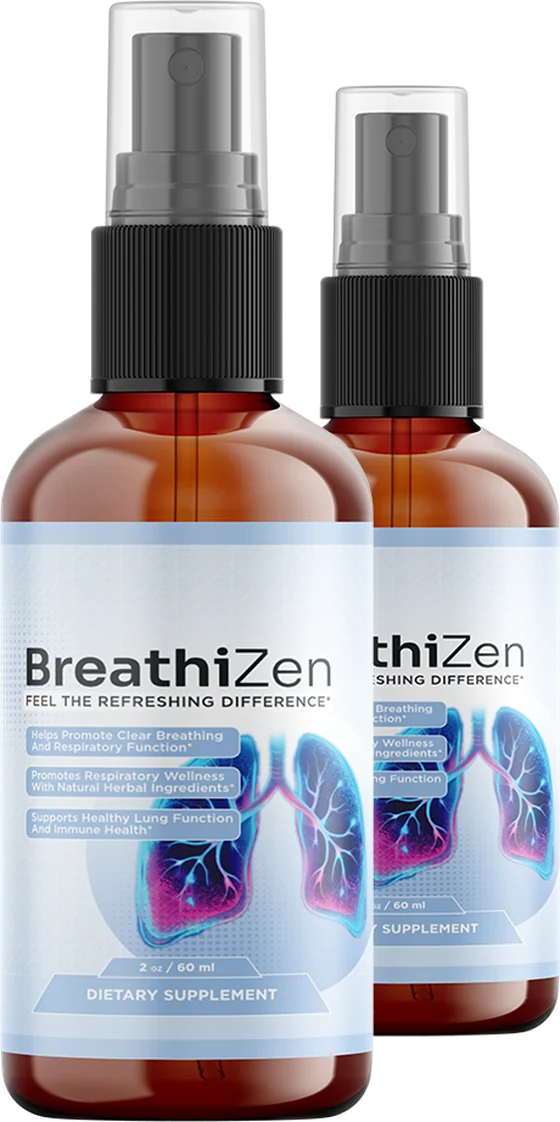
Two bottles
$79 per bottle
- Total at checkout$167.99
- Shipping$9.99
- Labeled servings200
- Per 4-pump serving$0.84
- Seller's supply claim60 days, $2.80/day
- Struck-through list price$358
- Kept vs. 2-bottle ordersbaseline
Breathizen is a liquid botanical supplement that many shoppers call Breathizen drops, yet its label directs 4 pumps (0.60 mL) of oral spray into the mouth once daily, 100 servings per 60 mL bottle. Each serving lists one 154 mg blend of mullein leaf extract 10:1, ginger root and organic lemon, without per-ingredient amounts. It is a dietary supplement, not an inhaler or medicine. Packs run $79 to $49 a bottle, with a 60-day refund on returned bottles.
Label vs. trial doses: checked November 8, 2026Checkout & refund terms: read on 4 seller pagesWho we are: an independent desk paid by commissionInvented: no doctors, no lab numbers, no stars
If you searched for the Breathizen official store, the order page our buttons open is the seller's own page on forbreathizen.com, with payment taken by BuyGoods. We are a separate desk and earn a commission on orders, at no extra cost to you.
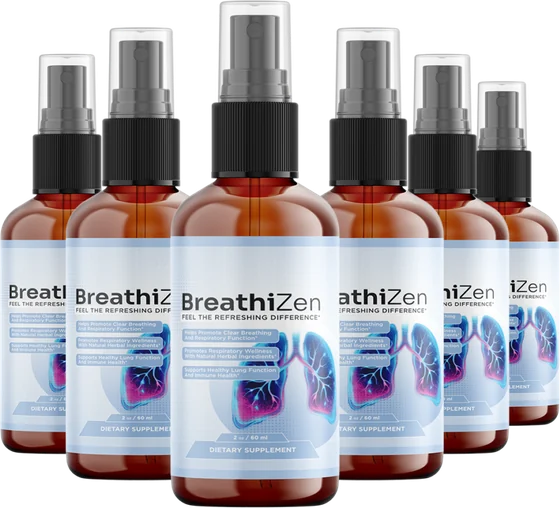
Seller's pack render. The bottles you receive carry a pump; the seller's single-bottle photo shows a dropper, which is where the "drops" name comes from.
Totals from the order page our links open, re-checked November 8, 2026. The seller's homepage shows a different 1, 3 and 6 bottle grid; both are compared in the package section.
Sixty-second buyer brief
If you only have a minute, these four cards carry the facts that decide whether an order makes sense. Every figure comes from the printed panel or the seller's own pages as they read on November 8, 2026.
Sixty milliliters of a water and glycerin liquid under a pump. Four pumps release 0.60 mL carrying 154 mg of blended mullein, ginger and lemon extract, about the weight of six or seven grains of rice split across three plants. At one serving a day a single bottle lasts 100 days.
Nothing on the panel is a stimulant, there is no capsule to swallow, and no added sugar is listed. The three plants have long folk use for coughs and throats, and the refund window is long enough to judge a daily habit, provided you keep the bottles and test each pump early.
The panel hides how the 154 mg divides. Ginger can be 77 mg at most, while human ginger trials usually give grams[1]. No human trial has tested oral mullein for breathing, and buyers on Trustpilot report pumps that jam after a few sprays.
Six bottles cost $294, which is $0.49 per labeled serving or $1.63 a day on the seller's own 180-day framing. Two bottles cost $167.99 with shipping, $0.84 a serving. Six bottles also mean 600 servings, far beyond the refund window, so three is the cautious middle.
Forensic audit · ads vs. the physical bottle
The fastest way to understand Breathizen is to set what the marketing says beside what the label and the seller's own legal pages say. The gap explains most buyer confusion, including the drops versus spray question that brings many readers here.
| What the ads and sales pages say | What the label and seller terms actually state | What it means for you |
|---|---|---|
| The seller's single-bottle photo shows an amber dropper bottle, and shoppers search for “Breathizen drops”. | The printed directions read: shake well, spray 4 pumps into the mouth or onto the tongue once daily. Every multi-pack photo shows a pump head. | Expect a pump spray. A serving is 0.60 mL, smaller than a typical dropperful, so counting drops will not match the label. |
| The dropper render's own label says “Fast-Acting Spray”. | The real panel makes three asterisked structure and function statements and no timing claim at all. | Nothing printed supports fast relief. Judge it over weeks, not minutes. |
| The sales page profiles five ingredients, including bromelain powder and organic cordyceps militaris. | The Supplement Facts panel lists three extracts inside one 154 mg proprietary blend. | Read your own bottle. If bromelain or cordyceps appear on it, the interaction picture changes (see the screener). |
| The same page carries paragraphs on green tea “fat burning”, L-theanine, chromium, vitamin D3 and a block titled “Inside Nervion” about nerve pain. | None of these appear anywhere on the Breathizen panel. | These are template leftovers from other products. Treat the sales page as advertising, and the panel as the record. |
| Two bottles are sold as a “60 Day Supply”, three as 90 days and six as 180 days. | 100 servings per bottle at one serving a day equals 100 days per bottle. | Either people are expected to use more than the label says, or the supply line is wrong. Per-day cost is $0.49 on the label and $1.63 on the seller's framing. |
| The order page promises a 100% refund for 60 days, “no questions asked”; the FAQ calls it unconditional. | The returns page asks for an email, every bottle back (full or empty) with the packing slip, and return postage paid by you. The homepage adds “after at least 30 days of use”. | Keep every bottle and the slip, and budget for tracked postage to Largo, Florida. |
| The refund clock starts on the date of purchase (homepage and returns page). | The terms of service say requests must arrive within 60 days of delivery. | Count from the order date. It is the earlier deadline and the one every page can accept. |
| Four five-star “Verified Purchase” testimonials with first names, surnames and cities. | The page footer says names and identifying details may have been changed. The one independent review profile we found, on Trustpilot, averages 2.2 out of 5 across 21 reviews, most of them about pump sprayers that clog. | Read the quotes as advertising, and test every pump on the day the parcel arrives. |
| “All ingredients are rigorously tested for quality and safety” and “no significant side effects have been reported”. | No certificate of analysis, lab name or test result is published anywhere on the seller's pages. | Ask for the CoA of your lot. A template email sits in the unboxing section. |
| “Produced in the United States in an FDA-registered facility”. | Facility registration is a listing with the FDA; the agency does not approve dietary supplements before sale. | It tells you where the bottle may have been filled, not whether it works. |
| “65% OFF”, with list prices of $358, $537 and $1,074 struck through. | We found no evidence that anyone ever paid those list prices. | Compare per-serving costs instead; a struck-through price is only meaningful if it was charged. |
| “Stock is limited and can run out quickly”. | The identical price grid was on the order page when we first logged it on November 2, 2026, and again on November 8, 2026. | There is no need to decide today; read the label and the refund rules first. |
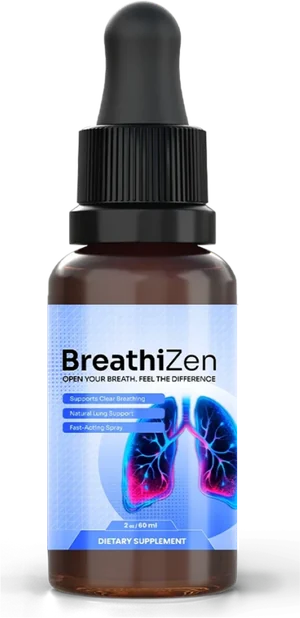
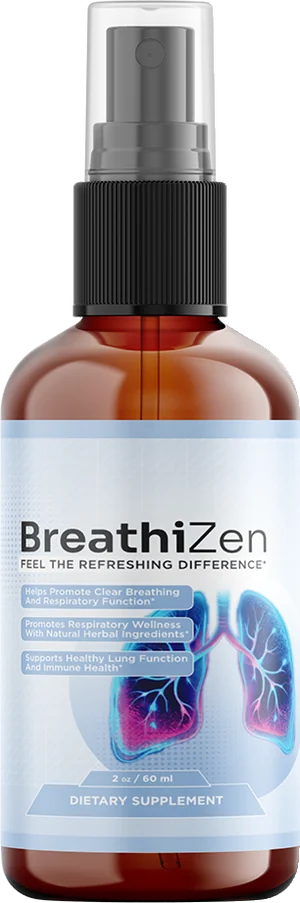
Why this matters for the drops question. A dropper bottle and a pump bottle are dosed differently. A dropperful is usually close to 1 mL, while one Breathizen serving is 0.60 mL from four pumps. If your parcel contains a dropper instead of a pump, photograph it, keep the packing slip and ask the seller which dose applies before you start.
Complete transcript · blend ceiling arithmetic
This is the panel printed on the bottle image the seller publishes, transcribed line for line. Underneath it, simple arithmetic shows the most and least each extract can weigh, because the law forces a hidden blend to list its ingredients from heaviest to lightest[2].
Serving Size: 4 Sprays (0.60 mL)
Servings Per Container: 100
Mullein (Verbascum thapsus)(leaf) Extract 10:1, Ginger (Zingiber officinale)(root) Extract, Organic Lemon Extract
† Daily Value not established.
Other Ingredients: Purified water, glycerin, natural flavors, citric acid, potassium sorbate, sodium benzoate.
Suggested use: Shake well before each use. Spray 4 pumps directly into mouth or onto tongue once daily.
Distributed by: GEX Corp, Lakeland FL 33804, +1 323-372-9581, [email protected]. Made in the USA with globally sourced ingredients. Manufactured in an FDA registered facility.
Under 21 CFR 101.36(c) a proprietary blend must show its total weight and list its parts in descending order of weight[2]. Three numbers follow from that single rule. Mullein, listed first, must be the heaviest share, so it holds at least a third of 154 mg, which is 51.3 mg, and anything up to just under the full 154 mg. Ginger, listed second, can never weigh more than mullein, so the most it can hold is half the blend, 77 mg. Lemon, listed last, can be no heavier than either, which caps it at a third, 51.3 mg.
An equal three-way split would put 51.3 mg of each extract in every serving. That is the only scenario in which ginger and lemon reach their ceilings at the same time, and it is as likely as any other split, because the label does not say.
The “10:1” next to mullein describes concentration. If it is a plant-to-extract ratio, which is the usual meaning, then at least 51.3 mg of extract stands for about 513 mg of dried leaf or more. The solvent, the standardization marker and the plant source are not printed, so two 10:1 extracts from different suppliers can differ a great deal.
The six other ingredients make up the rest of 0.60 mL. Water is the base; glycerin adds sweetness and a coating feel in the throat; citric acid adjusts acidity; potassium sorbate and sodium benzoate keep a water-based liquid from growing mold and yeast once it is opened.
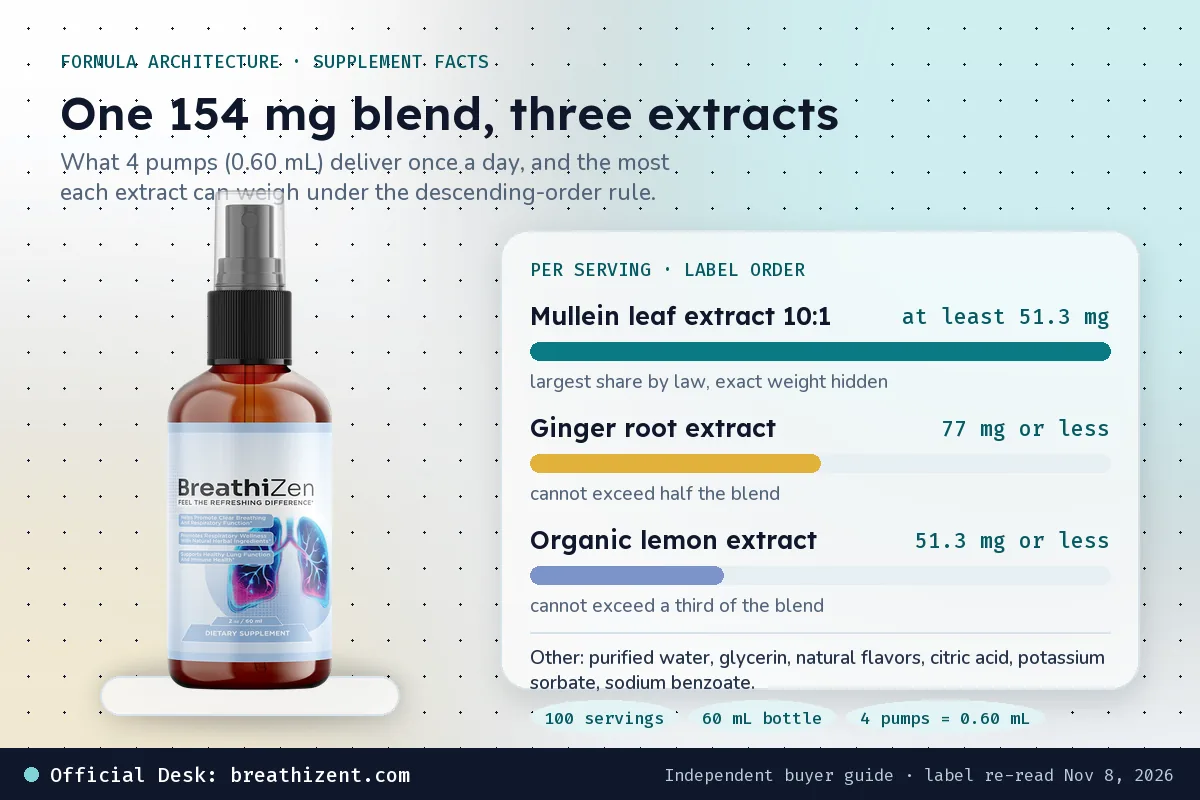
What the panel does not tell you. Per-ingredient milligrams, the extraction solvent, any standardized marker compound, the manufacturing plant's name and any batch test result. Those gaps are normal for a proprietary blend and they are the main reason our label-disclosure score is 4 out of 10.
Interactive tool 1 · dose, pack and cost per day
Pick a pack, the number of daily servings and the day you expect to order. The planner divides the real checkout total by the labeled servings, so shipping is included and the seller's “day supply” wording plays no part.
The twice-a-day option exists because one seller testimonial describes spraying “in the morning and again after work”; the label says once. Cost per gram uses the 154 mg blend weight, not any single extract. Dates assume the refund clock starts on the order date, the stricter of the seller's two readings.
Two things stand out once you play with it. First, the label dose makes Breathizen cheap per day on any pack, because a 60 mL bottle holds 100 servings: even the two-bottle order works out to $0.84 a serving with shipping. Second, the larger packs outlast the refund window by a long way. Six bottles at one serving a day is roughly a year and eight months of spray, and only the first 60 days are covered by the money-back promise. That is why we suggest deciding on value per serving and on how sure you are, not on the size of the struck-through discount.
Direct package pricing · three official order cards
These are the cards on the order page our buttons open: 2, 3 or 6 bottles at $79, $69 or $49 each. Shipping is $9.99 on two bottles and free on three or six. Each card adds the figures the seller does not print: the cost of one labeled serving and how much you keep compared with buying the same bottles two at a time[4].
$79 per bottle
$49 per bottle
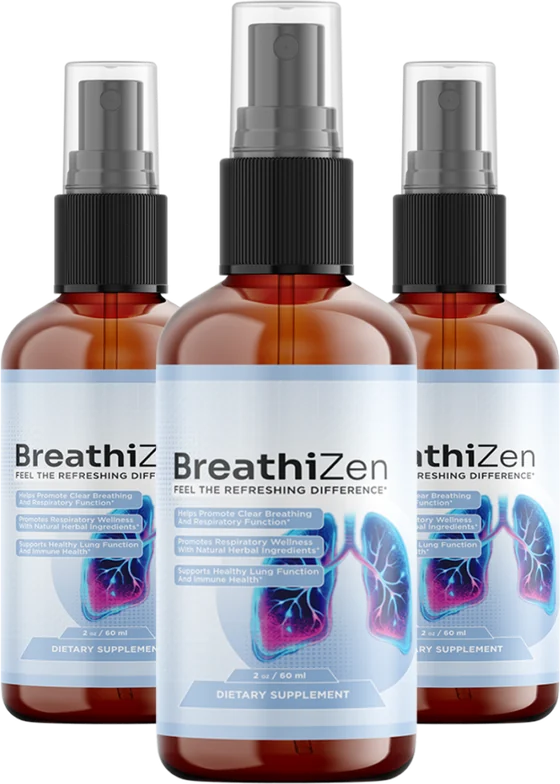
$69 per bottle
| Comparison | This order | Alternative | Difference |
|---|---|---|---|
| 6 bottles in one order vs. three 2-bottle orders | $294 | $503.97 | $209.97 |
| 3 bottles vs. the same bottles at the 2-bottle rate | $207 | $251.99 | $44.99 |
| 3 bottles: order page vs. seller homepage grid | $207 | $177 | $30 more on the order page |
| 6 bottles: order page vs. seller homepage grid | $294 | $294 | same price |
| Smallest entry: 2 bottles here vs. 1 bottle on the homepage | $167.99 | $89 + shipping | different commitment |
The struck-through prices of $358, $537 and $1,074 produce the advertised savings of $200, $330 and $780. We could not find a time when those list prices were charged, so we do not repeat them as savings. The honest comparison is the one in the table: a six-bottle order keeps $209.97 compared with three separate two-bottle orders, because it removes three shipping fees and $30 per bottle.
The seller's homepage runs a different grid: one bottle for $89 (struck from $179), three for $177 and six for $294, with five e-book bonuses listed on the three and six bottle options at stated values of $59, $49, $47, $49 and $39. The order page our links open shows no bonus line. If you want three bottles, the homepage price is $30 lower than the order page, and we would rather tell you that than lose your trust over it.
Checkout walkthrough · subscription trap check
Knowing the sequence in advance makes it easy to spot anything you did not ask for. This is the route as it ran on November 8, 2026.
The seller's FAQ answers this directly: no, the purchase is a one-time order. We saw no subscribe-and-save box on the order page, and the product codes behind the three buttons are single-purchase codes. That matches what we would expect from this checkout setup, but you are the last check: a recurring line in the summary, or a second charge a month later, is a reason to contact the seller the same day.
If an unexpected charge appears: email [email protected] with “Billing” in the subject, call +1 (507) 448-8190, and keep your BuyGoods receipt. Your card issuer's dispute process is the backstop, but give the seller a written chance first.
Because BuyGoods processes the payment, the line on your card statement normally names the payment processor rather than the product. Statement wording varies by bank, so match the amount and date to your receipt instead of looking for the word Breathizen.
Biological pathways · mechanism by evidence tier
The sales page says the formula reduces airway swelling, dissolves mucus and builds lung capacity. Here is each proposed pathway with the strongest evidence we could find, separated into laboratory work and human trials, because the distance between the two is where most supplement claims stretch.
| Proposed pathway | What the research shows | Type of evidence | What it means at the label dose |
|---|---|---|---|
| Throat coating from a sweet liquid base | Glycerin and a syrupy texture soothe the throat; sweet syrups show a real placebo and demulcent effect in cough research[5, 6] | Human studies of syrups, not of Breathizen | Most plausible reason a spray feels soothing within minutes |
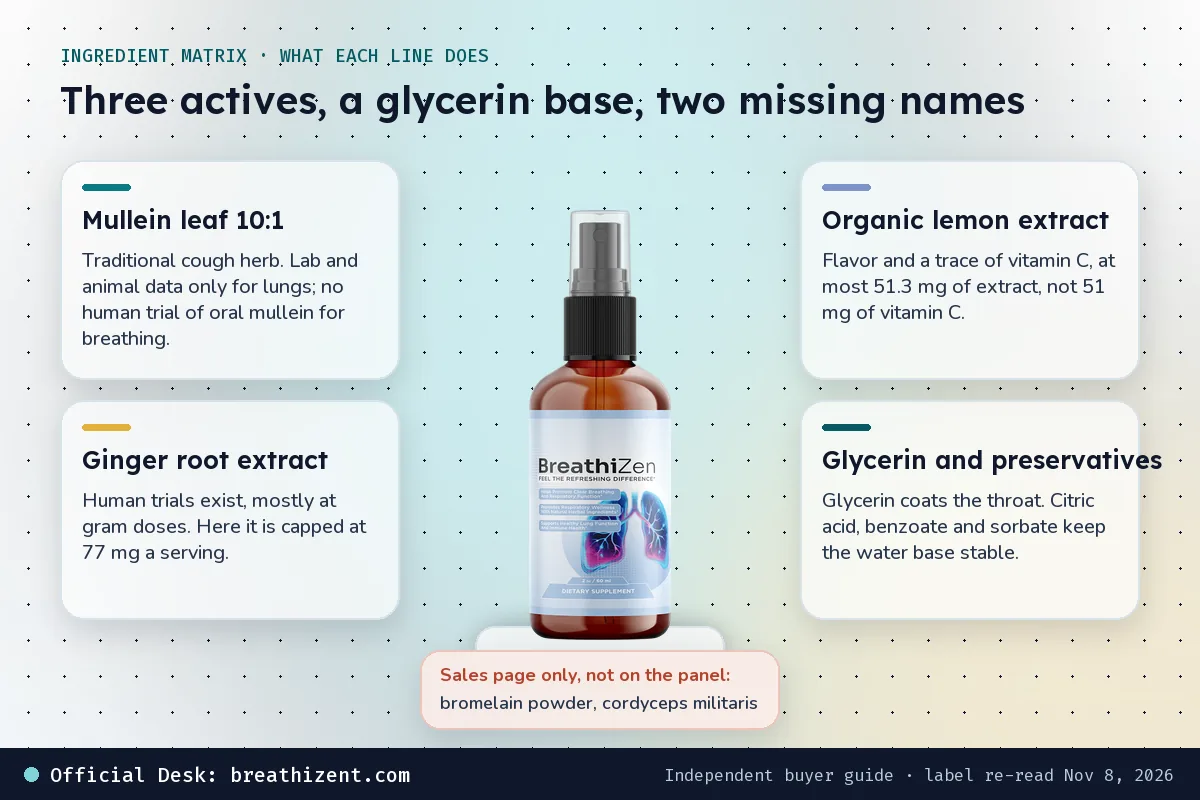
| Mullein: mucilage, saponins, verbascoside | Anti-inflammatory activity of verbascoside in cultured cells[7]; antiviral activity of a methanol extract in vitro[8]; long folk use as an expectorant[9, 10, 11] | Cell and animal work, traditional use | No human trial of oral mullein for breathing |
| Ginger: airway smooth muscle and immune signaling | Ginger compounds relaxed isolated airway muscle[12]; reduced Th2 allergy signaling in mice[13]; fresh ginger blocked a respiratory virus in cell lines[14] | Tissue, animal and cell studies | One small human asthma study used oral ginger capsules[15] |
| Lemon: vitamin C and flavonoids | Regular vitamin C of 200 mg or more shortened colds slightly but did not prevent them in the general population[3] | Large human meta-analysis | A lemon extract capped at 51.3 mg holds far less vitamin C than that |
| Absorption through the mouth lining | Sublingual and buccal routes work well for small, fat-soluble drug molecules[16] | Pharmaceutics review | Not shown for whole plant extracts; most of 0.60 mL is swallowed |
Most of what is known about mullein and about ginger's effect on the airways comes from cells in dishes, isolated tissue and mice. These studies are useful: they show which molecules are active and suggest where to look. They do not show that a few dozen milligrams swallowed once a day reach the lungs in a form and amount that matters. A compound that relaxes a strip of airway muscle in an organ bath is meeting that muscle directly at a concentration chosen by the researcher.
Mullein's verbascoside, for example, damped inflammatory signaling in a human monocyte cell line[7]. That is a reasonable first step toward a hypothesis, and it is also the whole of the human-relevant evidence for that compound in this context.
Ginger has the deepest human record of the three, with more than a hundred randomized trials, mostly on nausea, inflammation markers and metabolic outcomes, usually at doses between half a gram and three grams a day[1]. A small asthma study reported better daily symptom scores with low-dose oral ginger capsules[15], a promising but early result in a different product at a different dose.
For mullein, the only human trials we found involved ear drops for children's ear pain, where mullein was one of several herbs in oil[17, 18]. Those results say nothing about lungs. Lemon's relevant human evidence is really about vitamin C at doses the extract cannot reach.
Plain summary. The best-supported effect of a spray like this is the immediate soothing feel of a sweet, glycerin-based liquid in the throat. The plant-specific effects are plausible, unproven in people at this dose, and cannot reach the lungs by this route. None of it replaces an inhaler.
Ingredient-by-ingredient monographs
Each card puts the most the label allows next to what studies actually used, with the type of evidence behind each claim. Longer versions live on the ingredients page and in the mullein and ginger research notes.
Folk expectorant with antioxidant and anti-inflammatory compounds in lab work[19, 10]. The European herbal monograph covers the flower, not the leaf, for traditional cough use[20].
In this formula: Plausible soothing role; the leaf extract and the dose are both unstudied in people.
Airway muscle relaxation in tissue[12], anti-inflammatory and antioxidant activity reviewed in humans[21], and one small asthma study[15]. The European monograph lists traditional digestive uses[22].
In this formula: The best-studied plant here, present at a small fraction of studied doses.
Flavor, acidity and a modest amount of vitamin C and citrus flavonoids. Vitamin C research on colds used pure vitamin C, not lemon extract[3].
In this formula: Mainly a flavor and freshness ingredient at this weight.
The sales page also describes bromelain, a pineapple enzyme, and cordyceps militaris, a cultivated mushroom. Bromelain has been tried for sinus inflammation in small studies[23, 24], and cordyceps militaris for exercise tolerance[25]. Neither appears on the Supplement Facts panel, so neither can be assumed to be in the bottle. If your bottle prints them, read the interaction notes for both[26, 27].
A label can list a well-studied plant and still deliver too little of it to matter. Ginger is the clearest case here: even at its 77 mg ceiling, one serving delivers less than a tenth of a typical one-gram study dose. That does not make the product harmful or pointless, but it does mean the research on ginger cannot be borrowed to predict what this spray will do.
Buyer qualification matrix
This is not medical advice; it is the label's own cautions and the ingredient evidence turned into a quick sort. When in doubt, the middle column applies.
One honest point about expectations: breathing that has changed recently, a cough lasting more than a few weeks, coughing blood or waking at night short of breath all deserve a medical visit before any supplement[29, 30]. A herbal spray can sit alongside care for a stable, already-diagnosed condition, with your clinician's agreement. It should never be the first response to a symptom nobody has looked at.
Daily administration protocol
The label gives one sentence of directions; the seller's FAQ adds a time of day. Here they are as a routine, with the small details that make the taste and the absorption less variable.
Do not spray it into the nose or eyes, add it to a nebulizer, exceed the recommended dose, or stop any prescribed inhaler because you started it. Store it away from heat, light and humidity with the cap on, and out of reach of children and pets.
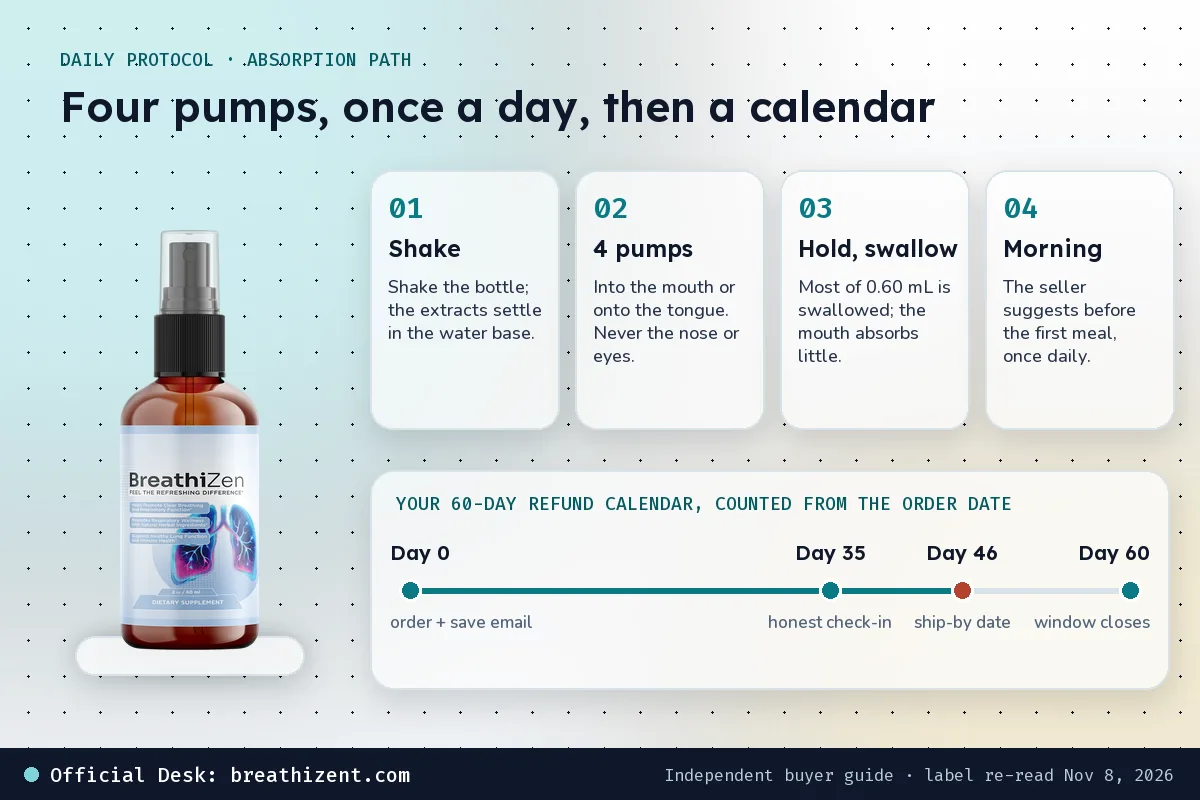
If you miss a day, do not double up; simply continue the next morning. If the spray stings, try it on the tongue rather than inside the cheek, and stop if the stinging persists, the lips or tongue swell, or a rash appears.
Realistic 90-day timeline
No herbal spray clears lungs overnight, whatever a testimonial says. The useful question is whether, after several weeks, you notice enough change to justify the cost, and whether you notice it before the refund window closes.
Check that the taste and any tingling are tolerable and that nothing upsets your stomach. Start a simple diary: morning cough count, throat comfort out of 10, stairs climbed without stopping.
Compare weekly averages, not single days. Weather, pollen, colds and sleep move breathing symptoms more than most supplements do, so note them alongside your scores.
Make an honest call by day 35. If you are returning it, email the seller and post every bottle by day 46 so the parcel arrives inside the 60 days.
Continue only if the diary shows a difference you would pay $0.49 to $0.84 a day for. A smaller pack next time is fine; nothing improves by buying more than you need.
Safety profile · interactive tool 2
The three listed extracts are common foods or long-used herbs, and the dose is small, so serious problems are unlikely in healthy adults. The risks that do exist come from interactions, allergies and, above all, from using a supplement instead of care that is needed.
Expect a sharp ginger and lemon taste and possibly a brief tingle or warmth in the mouth. Ginger in larger amounts is linked with heartburn, belching and mild stomach upset[31, 32]; at this dose those effects should be rare. Mullein is generally well tolerated by mouth[10], though the fine hairs on raw leaves can irritate, which is one reason extracts are filtered.
The preservatives, sodium benzoate and potassium sorbate, are widely used in foods and drinks at similar levels. No caffeine, no stimulant and no xylitol appear on the panel, which matters for people sensitive to caffeine and for households with dogs, since xylitol is toxic to them.
Stop using it and seek care for swelling of the lips, tongue or throat, hives, wheezing that starts after a dose, or any breathing difficulty at rest. Chest pain, blue lips or confusion with breathlessness are emergencies[30]. Report suspected reactions to the FDA through MedWatch[33]; the agency tracks supplement problems that way[34].
Ginger's possible effect on platelets is the interaction most worth knowing about[35]. A systematic review found mixed results, with effects mostly at higher doses, but anyone on anticoagulants should still ask first.
Tick anything that applies to you
The screener runs in your browser and stores nothing. It reflects the ingredients on the panel plus the two sales-page names; it does not replace a pharmacist's review of your full medication list. More detail on the safety page and in our blood thinner note.
Refund policy decoded · interactive tool 3
The promise is real and generous on paper, but the seller describes it four slightly different ways. Read side by side, the safe path is clear: count from the order date, return everything, keep proof of postage.
| Seller page | Window and start date | What you must do | Costs and timing |
|---|---|---|---|
| Order page (the page our buttons open) | 100% satisfaction, 60 days, “no questions asked” | Not stated | Not stated |
| Seller homepage and FAQ | 60 days from the date of purchase, “unconditional” | Contact by email “after at least 30 days of use” | Not stated |
| Returns page | 60 days starting the day the order was placed | Email with “Refund Request” in the subject; return all bottles, empty or not, with the packing slip or a note | You pay return shipping; card credit in 5 to 10 days after processing |
| Terms of service (GEX CORPORATION LLP) | Request within 60 days of delivery | Return the bottles, even empty | Processed in 3 to 5 business days; Barbados law and arbitration |
Refund deadline calculator
The ship-by date sits 14 days before the window closes so the parcel can reach Florida in time. Nothing you type leaves your browser.
Your worst case, in numbers: on a six-bottle order you would get back up to $294, minus whatever tracked postage to Florida costs you, and nothing for time spent. On a two-bottle order the $9.99 shipping you paid may not be refunded; the pages do not say. Full step-by-step guidance is on the refund page.
Manufacturing standards · CoA transparency · interactive tool 4
Supplement makers must follow the dietary supplement manufacturing rules in 21 CFR Part 111[36], and the FDA can inspect them. That is different from approval: the agency does not review a supplement's safety or effectiveness before it is sold[37].
The seller says ingredients are rigorously tested but publishes no certificate of analysis, no lab name and no lot results. We will not invent numbers to fill that gap. What we can do is tell you what a real CoA for a liquid botanical like this should list: identity testing for each extract (HPLC or HPTLC fingerprints), the actual total blend content per serving, heavy metals by ICP-MS against USP limits for lead, arsenic, cadmium and mercury, microbial counts and the absence of specified organisms under the USP supplement chapters, preservative levels, pH, and the lot number with test and release dates.
Note on the label: “Manufactured in an FDA registered facility” means the plant is on the FDA's food facility list. It is a legal requirement, not a quality badge, and the plant's name is not printed.
Copy and send to [email protected]: “Hello, I bought Breathizen (order number ______). Please send the certificate of analysis for lot ______, printed on my bottle, including identity tests for the three extracts, heavy metals and microbial results, and the name of the testing laboratory. Thank you.” A reply with a real document is a good sign; silence is information too.
Unboxing checklist · tick as you go
0 of 9 checks done
Ticks are kept only in this browser. If a pump will not prime, rinse the nozzle in warm water once; if it still jams, photograph it and email the seller that day, since the returns team needs the bottles back either way.
Authorized channel verification
The 60-day promise is written by the seller and runs through its returns address. A bottle bought from a marketplace reseller sits outside that chain: the seller has no record of your order, the packing slip it asks for does not exist, and the returns team has no reason to refund money it never received.
When we searched in November 2026 we found no marketplace listing operated by the seller. That may change, and listings appear and disappear quickly, so use three quick tests on any listing you find. First, does the seller name match the distributor on the bottle, GEX Corp, or the brand itself? Second, does the photo show the current pump bottle with the 154 mg panel, rather than the dropper render or a different label? Third, is the price far below $49 a bottle, which usually points to old, short-dated or returned stock?
None of this means a marketplace bottle is fake. It means you lose the refund route and the paperwork, which is most of what makes a first purchase of an unproven supplement reasonable. The FDA's advice on health fraud is worth a skim if a listing makes medical promises the label does not[38]. Our longer note covers how to check a listing.
Audited buyer landscape · reviews · complaints
Earlier this autumn the only praise for Breathizen came from the seller's page and paid press releases. That has changed: a Trustpilot profile now carries 21 reviews from people who describe buying the spray, and they are mostly unhappy. We show them as they are, without inventing a rating of our own.
| Source | What exists | What it shows | Caveat |
|---|---|---|---|
| Trustpilot profile “Breathizen Spray Reviews and Complaints” | 21 reviews, TrustScore 2.2 of 5 | 57% one-star, 19% two-star, 19% three-star, 5% five-star | Profile belongs to a third-party site, not the seller; reviewers describe buying the product |
| Second Trustpilot profile (breathizen-spray.lovable.app) | 2 reviews, 2.9 of 5 | Too few to read anything into | Same caveat |
| Seller testimonials | 4 five-star quotes | Named, with cities and “Verified Purchase” tags | Footer says names may be changed; not verifiable |
| Amazon, Walmart, eBay | No seller listing found | No marketplace reviews to read | Searched November 2026 |
| No buyer threads found | Searches return promotional pages | Searched November 2026 |
The dominant theme on Trustpilot is mechanical: many reviewers say the pump sprayers clogged or jammed after a few uses, sometimes on every bottle in a six or twelve bottle order. Others describe difficulty reaching customer service, slow refunds after posting bottles back, a burning feeling in the throat, and one report of an extra order added without consent. One reviewer says advertising presented a “Dr. Gupta” as the developer; we found no statement from any doctor of that name, and borrowed doctor names in supplement ads are a known warning sign.
There is also a constructive thread. One reviewer updated a one-star review after the company acknowledged a defective batch of bottles, sent tested replacements and restarted the guarantee. Another moved the liquid into a separate spray bottle and reports breathing much better after five months. One review simply says it did not work for that person.
Twenty-one reviews on a profile that the company does not manage are a small, self-selected sample, and Trustpilot itself warns that they may not be representative. Still, the same mechanical complaint from many unconnected buyers is the kind of signal a buyer should act on: test each pump on arrival, report problems in writing straight away, and keep every bottle for the refund.
Autocomplete tells the same story from another angle. Searches pair the brand with “reviews and complaints”, “is it a scam”, “is it legit” and with celebrity and doctor names. A product with a working refund route is not a scam in the legal sense, but marketing that leans on names it cannot document deserves the low accuracy score we give it. The reviews page keeps a dated log.
Form factor and market alternatives
A fair comparison includes the plain options. Some cost less and disclose more; the ones at the bottom of the table have far stronger evidence for breathing than any supplement. Spray, capsule, tea and syrup forms are compared in more depth in our form factor note.
| Option | What you know about the dose | Evidence for breathing or throat comfort | Cost per day | Refund |
|---|---|---|---|---|
| Breathizen spray | Three plants in a 154 mg blend, no split | Lab and traditional data; no product trial | $0.49 to $0.84 a serving | 60 days, bottles returned |
| Ginger capsules at study doses | Usually printed per capsule | Many human trials, mostly non-respiratory[1] | Varies by brand | Store policy |
| Mullein leaf or flower tea | Grams of dried herb per cup | Traditional use recognized in Europe for the flower[20] | Low per cup | Store policy |
| Honey for an irritated throat (adults, children over 1) | A spoonful | Meta-analysis support for cough relief in colds[39, 40] | Low | Not applicable |
| Breathing exercises and pulmonary rehab | Taught by a clinician or program | Cochrane-reviewed benefit for quality of life in asthma[41] | Often covered by insurance | Not applicable |
| Stopping smoking | Support programs, prescribed aids | Slows lung function decline in COPD[42] | Saves money | Not applicable |
Where Breathizen does have an edge is convenience: one small liquid dose, no brewing and no capsule. If that convenience matters to you and you accept the uncertainty, the spray is a reasonable thing to try under its refund window. If your aim is measurably better breathing, the evidence points first to the clinical options, then to clean air indoors and out[43, 44], and only then to herbs.
Editorial scorecard · methodology
The score is a plain average of six criteria, each marked out of 10 from the evidence on this page. It is our editorial judgment, not a customer rating, which is why it uses a ten-point scale and no stars. Full method on the about page.
Two bars would move the score most. A published certificate of analysis and per-ingredient amounts would lift label disclosure sharply, and a fixed pump plus one consistent refund policy would lift the refund bar. We re-read the seller's pages regularly and will re-score when either changes.
What people search about Breathizen
The brand is spelled several ways online, and the same eight questions keep coming up in search suggestions. Each answer leads with the fact you need.
Yes, it is one product. The seller's single-bottle photo shows a dropper, so many people search for drops, but the label and pack photos describe a pump spray: 4 pumps, 0.60 mL, once daily.
It is a real product sold through a real checkout with a written 60-day refund, so it is not a scam in the usual sense. The marketing overstates it, and Trustpilot buyers report clogged pumps and slow refunds.
No. It is a dietary supplement taken by mouth and cannot reach the airways. Keep every prescribed inhaler and plan unchanged.
Email [email protected] with Refund Request in the subject, then post every bottle with your packing slip to 11870 62nd St N, Largo, FL 33773 within 60 days of the order date.
No supplement is FDA approved. The label says it is made in an FDA registered facility, which is a facility listing, not an approval of the product.
We found no listing run by the seller on Amazon, Walmart or eBay in November 2026. Only orders through the seller's checkout carry the refund.
One 154 mg blend of mullein leaf extract 10:1, ginger root extract and organic lemon extract, in purified water with glycerin, natural flavors, citric acid, potassium sorbate and sodium benzoate.
The seller's support line is +1 (507) 448-8190 and the email is [email protected]. The bottle also prints a distributor number, +1 323-372-9581.
Answer-first FAQ
Shake the bottle and spray 4 pumps (0.60 mL) into your mouth or onto your tongue once a day, preferably in the morning before your first meal. Do not spray it into the nose or eyes.
At the label serving of 4 pumps once daily, a 60 mL bottle holds 100 servings, so it lasts about 100 days. The seller describes a bottle as roughly a 30-day supply, which would imply more than the label dose.
The seller's single-bottle product photo shows a dropper cap, and the product is a liquid. The bottles shipped in the pack photos and described on the label use a pump spray.
On the order page our buttons open: 2 bottles for $158 plus $9.99 shipping, 3 for $207 or 6 for $294 with free U.S. shipping. The seller's homepage lists 1 for $89, 3 for $177 and 6 for $294.
The seller's FAQ says the purchase is a one-time order, and we saw no subscription option on the order page. Check your receipt anyway, since one buyer reports an extra order added without consent.
Email the seller within 60 days, return every bottle (full or empty) with the packing slip at your own cost, and wait for processing. Count the 60 days from the order date, the stricter of the seller's two readings.
Rinse the nozzle in warm water and prime it again. If it still jams, photograph it and email the seller the same day for a replacement or refund; several buyers report this problem.
It is not proven to, and it must not replace treatment. No trial has tested Breathizen itself, the doses are small, and a mouth spray cannot reach the lungs.
Most people should notice nothing beyond a ginger and lemon taste or a brief tingle. Stomach upset, heartburn or throat burning are possible; swelling, hives or wheezing after a dose mean stop and seek care.
Anyone under 18, pregnant or nursing, or with a medical condition should ask a physician first, as the label says. People on blood thinners, diabetes or blood pressure medicines should ask a pharmacist.
The label says it is made in the USA with globally sourced ingredients and distributed by GEX Corp of Lakeland, Florida. Payment runs through BuyGoods, and refunds go to an Instituto Experience address in Largo, Florida.
No. This is an independent buyer guide that earns a commission on orders. The official order page is the seller's own, which our buttons open.
Thirty more answers, grouped by topic, are on the FAQ page.
Every source is linked to its original record. Studies cover single ingredients at their own doses and routes; none tested Breathizen or its 154 mg blend. Agency pages were reachable when checked.
Final showroom dispatch