
Ingredient monographs
Breathizen ingredients: three extracts sharing one 154 mg weight
Each ingredient gets the same treatment here: what the research actually tested, how close that comes to a 0.60 mL mouth spray, and the most the label rule lets the bottle contain. The two names that appear only in the advertising are covered too, clearly marked as absent from the panel.
How this page grades an ingredient
A plant name on a label is a starting point, not evidence. For each Breathizen ingredient we ask three questions: what kind of study exists, whether it used a similar route and dose, and how much of the ingredient the bottle can possibly deliver. The grade letters below are the shorthand used throughout this page and the mechanism page.
| Grade | What sits behind it |
|---|---|
| H1 | A human study of an oral product with a breathing-related outcome. |
| H2 | Human data, but for a different use, a different route or a much larger dose. |
| A | Animal experiments only. |
| C | Cell cultures or isolated tissue in a laboratory dish. |
| T | Traditional use or an official herbal monograph without trials on this use. |
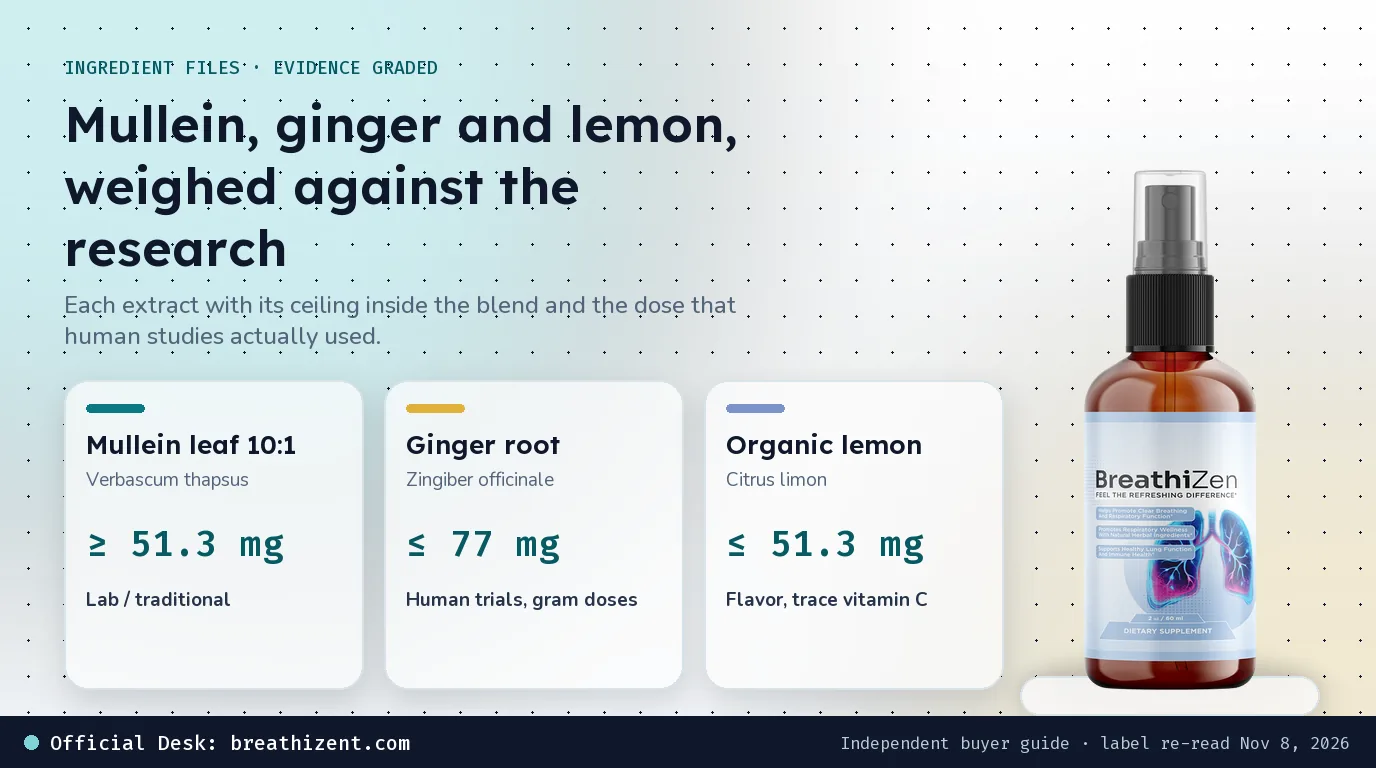
The dose ceilings come from the label arithmetic: a 154 mg blend listed in descending order caps ginger at 77 mg and lemon at 51.3 mg, and gives mullein a floor of 51.3 mg. None of the studies cited below tested Breathizen itself.
Mullein leaf extract 10:1: the lead ingredient
Verbascum thapsus, leaf, first in the blend
Common mullein is a tall, woolly roadside plant with a long folk history as a remedy for coughs and chest complaints. Two broad reviews describe that history and the laboratory work that followed[1, 2], and a third traces the Spanish folk uses back to their plant chemistry[3]. The compounds most often credited are iridoids, saponins, mucilage and phenylethanoid glycosides such as verbascoside.
The laboratory record is real but early. Extracts have shown antibacterial and other biological activity in screening tests[4], verbascoside dampened inflammatory signaling in a human monocyte cell line[5], and a methanol extract slowed an animal herpesvirus in cell culture[6]. Each result is a cell experiment, not a person breathing easier.
Human data are thin and indirect. The best known trials used ear drops containing mullein together with garlic, calendula and St. John's wort in olive oil for children's ear pain[7, 8]. That is a different route, a different mixture and a different complaint. The European Medicines Agency monograph recognizes traditional use for cough with colds, but it covers mullein flower prepared as a tea[9], while Breathizen uses leaf extract.
Ginger root extract: the most studied, the most capped
Zingiber officinale, root, second in the blend
Ginger is where the airway research is most interesting. In isolated airway smooth muscle, ginger and its pungent constituents relaxed contracted tissue and altered calcium handling[10]. In mice with an allergic asthma model, ginger reduced markers of the Th2 immune response[11]. Fresh ginger also blocked a respiratory virus from attaching to human airway cell lines[12]. Those are tiers C and A.
There is one small human study close to the topic. Adults with asthma who took oral ginger reported better daily symptom scores than with placebo[13]. The trial tested a measured oral product swallowed as a supplement, and its own title describes the dose as low, but it was not a mouth spray and it did not test a three-herb blend. Broader reviews of ginger's anti-inflammatory and antioxidant effects round out the picture[14].
Ginger's human trial record for other uses is large. A systematic review counted 109 randomized trials[15], and most of them gave between roughly half a gram and a few grams a day. The pregnancy nausea trials pooled in one meta-analysis typically used around a gram a day[16]. The European herbal monograph covers ginger for motion sickness and digestive complaints, not breathing[17].
Ginger is also the ingredient with the clearest safety footnote: some studies suggest an effect on platelets, although a systematic review found the evidence inconsistent[18]. The safety page covers who should check with a pharmacist.
Organic lemon extract: flavor first, vitamin C second
Citrus limon, third in the blend
The sales page credits lemon with antioxidants and vitamin C that "purify the respiratory pathways". The relevant evidence is the vitamin C research, and the best summary of it found that taking at least 200 mg of vitamin C every day did not reduce how often ordinary adults caught colds, though it shortened them modestly, by about 8 percent in adults and 14 percent in children[19].
Breathizen cannot reach that dose. The entire lemon extract is capped at 51.3 mg per serving, and an extract is mostly not vitamin C. The label does not say whether the extract comes from peel or juice, or whether any vitamin C survives in an acidic, preserved liquid. In a tart mouth spray, lemon most plausibly works as flavor and freshness.
The liquid base: water, glycerin, acid and two preservatives
Four of the six other ingredients exist to make a stable, pleasant liquid. Purified water carries everything. Glycerin gives body and a sweet taste; in cough syrups it is valued as a demulcent that coats and soothes the throat[20], and sweet taste itself appears to trigger soothing reflexes and saliva, which is part of why syrups feel helpful even without active drugs[21].
Citric acid adds tartness and lowers the pH, which matters because potassium sorbate and sodium benzoate, the two preservatives, work best in acidic conditions. Both are common food preservatives that keep mold and bacteria out of a water-based product opened every day for months. Natural flavors is a collective term; the label does not say which flavorings are used.
If soothing a scratchy throat is what you are actually after, it helps to know the comparison. Honey has more human evidence for easing cough and cold symptoms than anything on this panel, including a meta-analysis in upper respiratory infections[22] and a trial in coughing children over one year old[23]. That does not make Breathizen useless; it explains where a soothing sensation may come from.
Bromelain and cordyceps: in the ads, not on the panel
The homepage ingredient list adds two names that the Supplement Facts panel does not include. We cover them because buyers ask, and because the research on them is often quoted next to Breathizen.
Bromelain is a group of protein-digesting enzymes from pineapple stem. Small studies have tested oral bromelain tablets in chronic rhinosinusitis[24] and in children with acute sinusitis[25]. Health agencies describe the evidence as limited and note possible bleeding interactions and allergy in people sensitive to pineapple[26, 27].
Cordyceps militaris is a cultivated fungus. The study usually cited tested a mushroom blend containing it in people doing high-intensity exercise[28], which measured exercise tolerance rather than breathing comfort. Cancer center herb references list it as under-researched in people[29].
What would move these grades up
Grades are not fixed verdicts. Three pieces of information from the seller would change this page overnight, and none of them would cost much to publish.
- Individual milligrams. If the label showed, for example, that ginger sits at its 77 mg ceiling, the dose gap could be judged exactly instead of as a range.
- A marker compound. A stated percentage of verbascoside in the mullein, or gingerols in the ginger, would let anyone compare the extract with the material used in published work.
- A study of the finished spray. Even a small trial of Breathizen itself, with a placebo spray and a breathing questionnaire, would outrank every cell study cited here.
Until then, the fairest summary is that each ingredient has a plausible story and none has a proven dose in this format. If the seller publishes any of the three, write to the desk and we will re-grade the page with the date of the change.
Side by side: what the bottle can hold against what was studied
Put the grades and the ceilings together and a clear pattern appears. The ingredient with the most human research, ginger, is the one most limited by the label. The lead ingredient, mullein, has the most room in the blend but the least human evidence for oral use. Lemon is a flavor at this scale.
| Ingredient | Most it can be per serving | Where the research comes from | Grade |
|---|---|---|---|
| Mullein leaf extract 10:1 | <154 mg | Cell studies, reviews, a flower-tea monograph, ear drops in children | C, T |
| Ginger root extract | 77 mg | Isolated airway muscle, mice, cell lines, one small human asthma study, many oral trials for other uses | H1 (small), C, A |
| Organic lemon extract | 51.3 mg | Vitamin C trials at 200 mg and above of pure vitamin C | T, flavor |
| Glycerin (base) | not stated | Cough-syrup research on soothing and sweetness | H2 |
| Bromelain (sales page only) | not on the panel | Oral tablets in sinus conditions | H2, not in this bottle |
| Cordyceps militaris (sales page only) | not on the panel | A mushroom blend in exercise tests | H2, not in this bottle |
That does not prove the spray does nothing. It means the evidence cannot tell you in advance whether it will help you, which is why the most useful tool is a fair personal trial inside the refund window. The cost and dose planner on the home page works out the dates, and our research notes go deeper on mullein leaf 10:1, ginger and the airways and how to read a 154 mg blend.
Ingredient questions, answered first
What are the ingredients in Breathizen?
Three botanical extracts in one 154 mg proprietary blend: mullein leaf extract 10:1, ginger root extract and organic lemon extract. The other ingredients are purified water, glycerin, natural flavors, citric acid, potassium sorbate and sodium benzoate.
How much ginger is in Breathizen?
No more than 77 mg per serving. The label hides individual weights, but ginger is listed second in a 154 mg blend, so it can never outweigh mullein and therefore never exceed half the blend.
Is there enough ginger to match the studies?
Unlikely. Most human ginger trials used roughly half a gram to a few grams a day, and the one small asthma study tested a swallowed oral product. Breathizen's ceiling of 77 mg sits far below those intakes.
Does mullein help the lungs?
Mullein has a long traditional use for coughs and promising cell studies, but no oral human trial of mullein leaf for breathing that we could find. The European herbal monograph covers mullein flower tea for coughs with colds, not leaf extract.
Why is lemon in the formula?
Mainly for taste. The vitamin C research that is often quoted used at least 200 mg of pure vitamin C a day, while Breathizen's whole lemon extract is capped at 51.3 mg per serving and is not pure vitamin C.
Does Breathizen contain bromelain or cordyceps?
Not on the label we transcribed. The seller's homepage describes both, but the Supplement Facts panel lists neither. If your bottle lists them, check them with a pharmacist, especially if you take a blood thinner.
Are the preservatives safe?
Potassium sorbate and sodium benzoate are widely used food preservatives that keep a water-based liquid free of mold and bacteria. They can irritate a sensitive mouth in some people; stop using the spray if your mouth burns or swells.
Sources linked from this page
Each link opens the original record. The studies tested single ingredients at their own doses and routes; none of them tested the Breathizen spray or its 154 mg blend.
- 1Turker AU, Gurel E. Common mullein (Verbascum thapsus L.): recent advances in research. Phytother Res. 2005;19(9):733-739. pubmed.ncbi.nlm.nih.gov/16222647/
- 2Gupta A, Atkinson AN, Pandey AK, Bishayee A. Health-promoting and disease-mitigating potential of Verbascum thapsus L. (common mullein): a review. Phytother Res. 2022;36(4):1507-1522. pubmed.ncbi.nlm.nih.gov/35088467/
- 3Blanco-Salas J, Hortigón-Vinagre MP, Morales-Jadán D, Ruiz-Téllez T. Searching for scientific explanations for the uses of Spanish folk medicine: a review on the case of mullein (Verbascum, Scrophulariaceae). Biology (Basel). 2021;10(7):618. pubmed.ncbi.nlm.nih.gov/34356473/
- 4Turker AU, Camper ND. Biological activity of common mullein, a medicinal plant. J Ethnopharmacol. 2002;82(2-3):117-125. pubmed.ncbi.nlm.nih.gov/12241986/
- 5Speranza L, Franceschelli S, Pesce M, et al. Antiinflammatory effects in THP-1 cells treated with verbascoside. Phytother Res. 2010;24(9):1398-1404. pubmed.ncbi.nlm.nih.gov/20812283/
- 6Escobar FM, Sabini MC, Zanon SM, Tonn CE, Sabini LI. Antiviral effect and mode of action of methanolic extract of Verbascum thapsus L. on pseudorabies virus (strain RC/79). Nat Prod Res. 2012;26(17):1621-1625. pubmed.ncbi.nlm.nih.gov/21999656/
- 7Sarrell EM, Mandelberg A, Cohen HA. Efficacy of naturopathic extracts in the management of ear pain associated with acute otitis media. Arch Pediatr Adolesc Med. 2001;155(7):796-799. pubmed.ncbi.nlm.nih.gov/11434846/
- 8Sarrell EM, Cohen HA, Kahan E. Naturopathic treatment for ear pain in children. Pediatrics. 2003;111(5 Pt 1):e574-e579. pubmed.ncbi.nlm.nih.gov/12728112/
- 9European Medicines Agency, Committee on Herbal Medicinal Products. Verbasci flos (mullein flower): herbal medicinal product summary and monograph. www.ema.europa.eu/en/medicines/herbal/verbasci-flos
- 10Townsend EA, Siviski ME, Zhang Y, et al. Effects of ginger and its constituents on airway smooth muscle relaxation and calcium regulation. Am J Respir Cell Mol Biol. 2013;48(2):157-163. pubmed.ncbi.nlm.nih.gov/23065130/
- 11Khan AM, Shahzad M, Raza Asim MB, et al. Zingiber officinale ameliorates allergic asthma via suppression of Th2-mediated immune response. Pharm Biol. 2015;53(3):359-367. pubmed.ncbi.nlm.nih.gov/25420680/
- 12Chang JS, Wang KC, Yeh CF, Shieh DE, Chiang LC. Fresh ginger (Zingiber officinale) has anti-viral activity against human respiratory syncytial virus in human respiratory tract cell lines. J Ethnopharmacol. 2013;145(1):146-151. pubmed.ncbi.nlm.nih.gov/23123794/
- 13Emala CW, Saroya TK, Miao Y, Wang S, Sang S, DiMango EA. Low-dose oral ginger improves daily symptom scores in asthma. Pharmaceuticals (Basel). 2024;17(12):1651. pubmed.ncbi.nlm.nih.gov/39770492/
- 14Mashhadi NS, Ghiasvand R, Askari G, et al. Anti-oxidative and anti-inflammatory effects of ginger in health and physical activity: review of current evidence. Int J Prev Med. 2013;4(Suppl 1):S36-S42. pubmed.ncbi.nlm.nih.gov/23717767/
- 15Anh NH, Kim SJ, Long NP, et al. Ginger on human health: a comprehensive systematic review of 109 randomized controlled trials. Nutrients. 2020;12(1):157. pubmed.ncbi.nlm.nih.gov/31935866/
- 16Viljoen E, Visser J, Koen N, Musekiwa A. A systematic review and meta-analysis of the effect and safety of ginger in the treatment of pregnancy-associated nausea and vomiting. Nutr J. 2014;13:20. pubmed.ncbi.nlm.nih.gov/24642205/
- 17European Medicines Agency, Committee on Herbal Medicinal Products. Zingiberis rhizoma (ginger): herbal medicinal product summary and monograph. www.ema.europa.eu/en/medicines/herbal/zingiberis-rhizoma
- 18Marx W, McKavanagh D, McCarthy AL, et al. The effect of ginger (Zingiber officinale) on platelet aggregation: a systematic literature review. PLoS One. 2015;10(10):e0141119. pubmed.ncbi.nlm.nih.gov/26488162/
- 19Hemilä H, Chalker E. Vitamin C for preventing and treating the common cold. Cochrane Database Syst Rev. 2013;(1):CD000980. pubmed.ncbi.nlm.nih.gov/23440782/
- 20Eccles R, Mallefet P. Soothing properties of glycerol in cough syrups for acute cough due to common cold. Pharmacy (Basel). 2017;5(1):4. pubmed.ncbi.nlm.nih.gov/28970416/
- 21Eccles R. Mechanisms of the placebo effect of sweet cough syrups. Respir Physiol Neurobiol. 2006;152(3):340-348. pubmed.ncbi.nlm.nih.gov/16326149/
- 22Abuelgasim H, Albury C, Lee J. Effectiveness of honey for symptomatic relief in upper respiratory tract infections: a systematic review and meta-analysis. BMJ Evid Based Med. 2021;26(2):57-64. pubmed.ncbi.nlm.nih.gov/32817011/
- 23Paul IM, Beiler J, McMonagle A, et al. Effect of honey, dextromethorphan, and no treatment on nocturnal cough and sleep quality for coughing children and their parents. Arch Pediatr Adolesc Med. 2007;161(12):1140-1146. pubmed.ncbi.nlm.nih.gov/18056558/
- 24Büttner L, Achilles N, Böhm M, Shah-Hosseini K, Mösges R. Efficacy and tolerability of bromelain in patients with chronic rhinosinusitis: a pilot study. B-ENT. 2013;9(3):217-225. pubmed.ncbi.nlm.nih.gov/24273953/
- 25Braun JM, Schneider B, Beuth HJ. Therapeutic use, efficiency and safety of the proteolytic pineapple enzyme Bromelain-POS in children with acute sinusitis in Germany. In Vivo. 2005;19(2):417-421. pubmed.ncbi.nlm.nih.gov/15796206/
- 26National Center for Complementary and Integrative Health. Bromelain: Usefulness and Safety. www.nccih.nih.gov/health/bromelain
- 27Memorial Sloan Kettering Cancer Center, About Herbs. Bromelain. www.mskcc.org/cancer-care/integrative-medicine/herbs/bromelain
- 28Hirsch KR, Smith-Ryan AE, Roelofs EJ, Trexler ET, Mock MG. Cordyceps militaris improves tolerance to high-intensity exercise after acute and chronic supplementation. J Diet Suppl. 2017;14(1):42-53. pubmed.ncbi.nlm.nih.gov/27408987/
- 29Memorial Sloan Kettering Cancer Center, About Herbs. Cordyceps. www.mskcc.org/cancer-care/integrative-medicine/herbs/cordyceps
Order with the paperwork already in hand
The button opens the seller's own order page, where BuyGoods takes payment. Before you pay, note today's date, save the confirmation email the moment it lands, and put the return ship-by date in your calendar. That one habit turns a 60-day promise into a refund you can actually collect.