
Label transcript
Breathizen Supplement Facts, transcribed and checked line by line
Every figure on this page comes from the seller's own label image, re-read on November 8, 2026. You get the panel as printed, the arithmetic the blend rule permits, the gaps the panel leaves, and a worksheet for checking the bottle that lands on your doorstep against all of it.
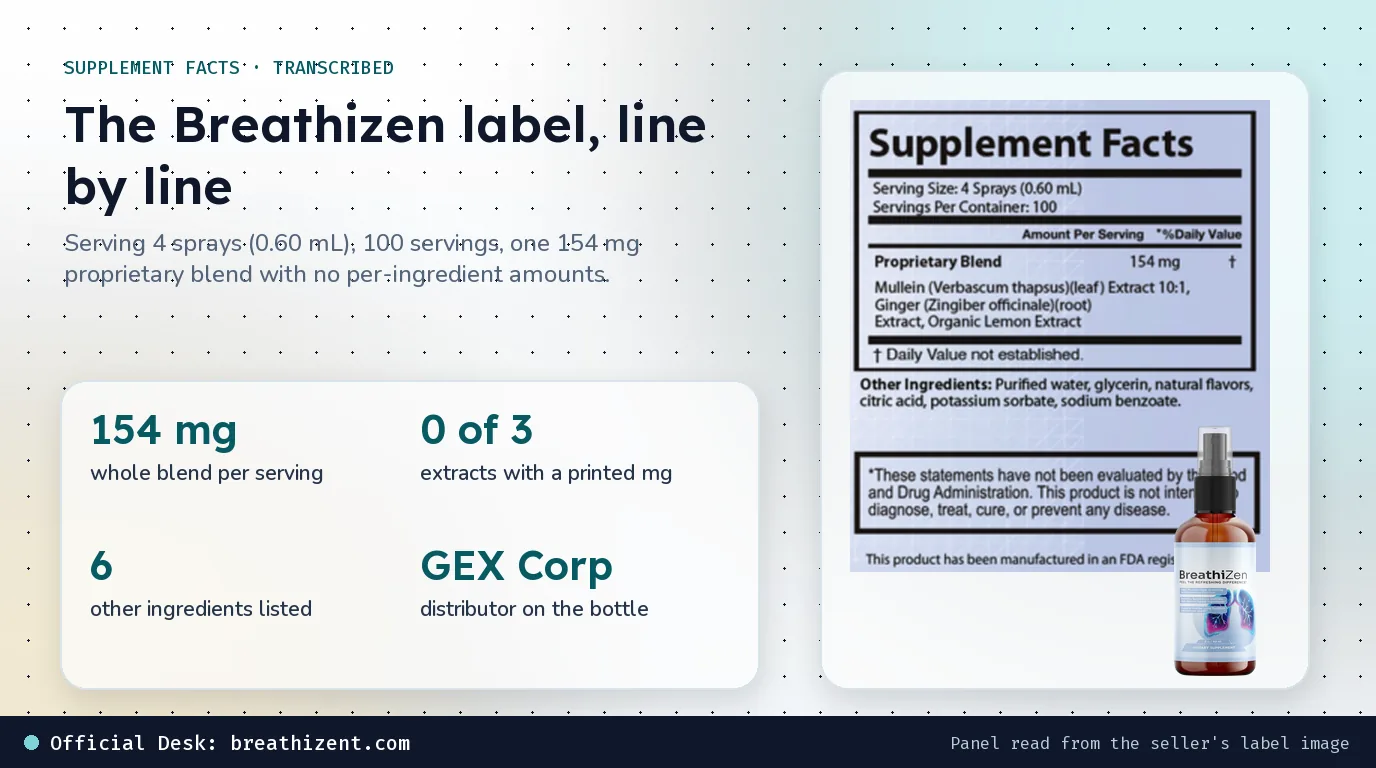
The Supplement Facts panel, line by line
The panel on the Breathizen bottle is one of the shortest you will meet on a botanical product. It declares a serving, a container count, one blend weight and three ingredient names. Everything else on this page is either taken straight from that panel or calculated from it, and every calculation is shown so you can redo it with a pencil.
The transcript below follows the seller's own label image as it stood on November 8, 2026. If the bottle that reaches you prints anything different, the bottle wins, and the worksheet further down tells you what to do about it. The legal format for this kind of panel, including how a blend may be shown, is set out in 21 CFR 101.36[1].
| Label line | As printed | What it tells you |
|---|---|---|
| Serving size | 4 Sprays (0.60 mL) | One dose is four presses of the pump, a little more than half a milliliter of liquid. |
| Servings per container | 100 | Taken once a day as directed, a single bottle covers one hundred days. |
| Proprietary Blend | 154 mg † | The combined weight of all three extracts in one dose. The dagger means no Daily Value exists. |
| First blend item | Mullein (Verbascum thapsus) (leaf) Extract 10:1 | Listed first, so it is the heaviest of the three. Its own weight is not printed. |
| Second blend item | Ginger (Zingiber officinale) (root) Extract | Weighs the same as mullein or less. No milligram figure. |
| Third blend item | Organic Lemon Extract | The lightest item, or tied for lightest. No milligram figure. |
| Footnote | † Daily Value not established | None of the three botanicals has a government reference intake to compare against. |
| Other ingredients | Purified water, glycerin, natural flavors, citric acid, potassium sorbate, sodium benzoate | The liquid base, a sweet carrier, flavoring, an acid and two preservatives. |
| %Daily Value column | Empty except the dagger | No vitamin or mineral is declared, so there is nothing to total against a daily reference. |
Directions, storage, caution and the distributor block
The rest of the label wraps around the panel. It is worth reading slowly, because three of its lines settle questions that the sales page leaves open: how the liquid is meant to be used, who should ask a doctor first, and who actually puts the bottle on the market.
Two details stand out. First, the directions describe a pump spray aimed at the mouth or the tongue, not drops counted from a pipette. Second, the label names a distributor rather than a manufacturer, so the only company you can reach from the bottle itself is GEX Corp in Lakeland, Florida.
| Carton panel | What the label says (paraphrased where noted) |
|---|---|
| Suggested use | "Shake well before each use. Spray 4 pumps directly into mouth or onto tongue once daily." (quoted) |
| Storage | Keep away from heat, light and humidity; store in a cool, dry place. |
| Caution (paraphrased) | Do not go above the recommended dose. Pregnant or nursing mothers, anyone under 18 and anyone with a known medical condition should speak to a physician before use. |
| Child and seal warning (paraphrased) | Keep out of children's reach. Do not use the bottle if the safety seal is damaged or missing. |
| Distributed by | GEX Corp, Lakeland, FL 33804, +1 323-372-9581, [email protected] |
| Origin line | Made in the USA with globally sourced ingredients |
| Net contents | 2 oz / 60 ml, dietary supplement |
| Facility line | This product has been manufactured in an FDA registered facility |
| Front claims (all asterisked) | Helps Promote Clear Breathing And Respiratory Function*; Promotes Respiratory Wellness With Natural Herbal Ingredients*; Supports Healthy Lung Function And Immune Health* |
The phone number on the label (+1 323-372-9581) is not the number on the seller's contact page (+1 (507) 448-8190). Both share the same support inbox, [email protected]. For anything about an order, the contact-page number and the inbox are the routes the returns page itself points to; our contact map lists every channel side by side.
Blend ceiling arithmetic: what the descending-order rule lets you work out
Federal labeling rules let a company hide the individual weights inside a proprietary blend, but they require the ingredients to be listed from heaviest to lightest[1]. That single requirement is enough to put hard floors and ceilings on each Breathizen extract, even though no individual weight is printed.
The logic runs like this. Mullein is listed first, so nothing can outweigh it. If mullein weighed less than a third of 154 mg (51.3 mg), the other two would have to carry more than 102.7 mg between them, and one of them would end up heavier than mullein, which the order forbids. Ginger cannot weigh more than mullein, so ginger and mullein together reach at most 154 mg when they are equal, which caps ginger at 77 mg. Lemon cannot outweigh ginger, so lemon tops out at a third of the blend.
| Blend item | Smallest it can be | Largest it can be | Even three-way split |
|---|---|---|---|
| Mullein leaf extract 10:1 | 51.3 mg | just under 154 mg | 51.3 mg |
| Ginger root extract | above 0 mg | 77 mg | 51.3 mg |
| Organic lemon extract | above 0 mg | 51.3 mg | 51.3 mg |
| All three together | 154 mg | 154 mg | 154 mg |
Scale that up and one 60 mL bottle carries 15.4 g of blend in total (154 mg times 100 servings), or roughly 257 mg per milliliter. Each single press of the pump delivers about 0.15 mL and 38.5 mg of the blend.
The "10:1" after mullein describes a concentration ratio. If it means ten parts of dried leaf went into one part of finished extract, then 51.3 mg of extract corresponds to about half a gram of leaf, and the theoretical maximum corresponds to about 1.5 g. A ratio describes the input, not the strength of any active compound, so it cannot be compared with a study dose unless a marker compound is also declared, and none is.
What the panel leaves out
A short panel is not automatically a bad one, but a buyer should know which questions it cannot answer. These are the gaps we could not fill from any page the seller publishes:
- Individual milligrams. The 154 mg is shared three ways in unknown proportions, so the bounds above are the most anyone outside the company can say.
- What the 154 mg is weighed as. In a water and glycerin liquid, the figure could be dry extract dissolved into the base or a portion of a liquid extract. The label does not say, and the two readings are not the same amount of plant material.
- Extraction solvent. Water, glycerin and alcohol pull different compounds out of a leaf. No solvent is named, and alcohol does not appear in the other ingredients.
- Standardization markers. Mullein research often tracks verbascoside, ginger research tracks gingerols and shogaols, and citrus research tracks flavonoids or vitamin C. No marker or percentage is printed.
- Lot test results. There is no published certificate of analysis for identity, heavy metals or microbial limits. A lot code identifies a batch; it is not a test result.
- The maker. Only a distributor is named. The plant is described as an "FDA registered facility" without a name or a city.
- The lemon and the flavor. Peel or juice is not specified, and "natural flavors" can cover many approved flavoring substances without listing them.
Federal good manufacturing practice rules still apply to whoever made the liquid[2], and they require identity testing and specifications behind the scenes. They do not require any of it to be shown to you, which is why our index has an unboxing checklist and a template for asking the seller for your lot's paperwork.
Names on the sales page that never reach the panel
The seller's homepage describes five ingredients, not three. Next to mullein, ginger and lemon it praises bromelain powder for "dissolving thick mucus" and organic Cordyceps militaris fruit extract for lung capacity. Neither name appears anywhere on the Supplement Facts panel we transcribed. If they are not on the panel, they are not a declared part of the product you buy, and any research about them[3, 4] tells you nothing about this bottle.
The same homepage also carries copy that belongs to unrelated products. There are paragraphs on green tea extract and its EGCG described for fat burning, on L-theanine, on chromium and vitamin D3 framed around weight loss, and a paragraph that opens with the words "Inside Nervion" and describes nerve pain. Image files on the page are named for California poppy, corydalis and marshmallow root, none of which is on the panel either.
Advertising claims, testimonials and endorsements on a sales page are governed by federal advertising rules rather than by the label rules[5], which is one reason the two documents can drift so far apart.
We list every sales-versus-label mismatch in one table on the home page, in the ad promises versus bottle reality section, and the two missing ingredients are covered in their own block on the ingredients page.
A dropper in one photo, a pump in the directions
This is the detail that explains why so many people search for "Breathizen drops". The seller's single-bottle photo shows an amber bottle topped with a black rubber dropper bulb, and its label tag even reads "Fast-Acting Spray" under the slogan "Open your breath. Feel the difference." The two-, three- and six-bottle photos show the same amber bottle with a pump sprayer and a clear overcap, and the label artwork on those reads "Feel the refreshing difference".
The Supplement Facts panel settles which one you are meant to receive: the serving is measured in sprays, and the directions say to spray four pumps into the mouth. Plan for a pump. If a dropper bottle arrives instead, you have no printed way to convert droppers into the 0.60 mL serving, so write to the seller before using it and keep the packaging. Our research note on drops versus spray walks through both renders in detail.
Read your own bottle: a seven-step worksheet
Labels change between production runs, and the photo on a sales page can lag behind the bottle in the warehouse. Five minutes with the parcel on the kitchen table tells you whether what you paid for matches what is printed here.
- Photograph before opening. Take a picture of the box, the bottle and the shrink band over the cap. The label says not to use the bottle if that seal is damaged or missing.
- Match the panel. Look for 4 sprays (0.60 mL), 100 servings and a 154 mg blend of mullein, ginger and lemon in that order. Any change in the numbers or the order is worth a note.
- Scan the other ingredients. Compare them with the six listed above. A new item, such as alcohol, xylitol, bromelain or cordyceps, changes the safety picture and should be checked with a pharmacist[6].
- Check the closure and the volume. Pump or dropper, and 2 fl oz / 60 mL on the front. Note which one you received.
- Record the lot and expiry. They are usually stamped on the base or the label edge. Write them next to your order number and order date.
- Test every pump on day one. Prime each bottle's pump into a tissue, then press four times into a 1/8 teaspoon measure. That spoon holds about 0.62 mL, so four presses should come close to filling it. Jammed sprayers are the complaint independent reviewers report most, so if one sticks, photograph it with the lot number and email the seller the same day.
- Keep the paperwork. The returns page asks for every bottle and the packing slip, so keep both, plus the outer box, until your refund window has closed.
The same checks, with tick boxes that remember your progress, sit in the unboxing checklist on the home page.
Reading the asterisks and the facility line
Each of the three front-label statements ends in an asterisk that points to the standard notice: the statements have not been evaluated by the FDA, and the product is not intended to diagnose, treat, cure or prevent any disease. That pairing is how structure/function claims are allowed to appear on supplements[7]. The FDA does not approve supplements or their wording before sale, and it does not check whether a botanical spray supports lung function[8].
"Manufactured in an FDA registered facility" means the plant is listed with the agency as a food facility. Registration is an administrative step; it is not an inspection result, a certification or an endorsement of the product. Claims that a supplement can treat a lung disease would cross into territory the FDA treats as health fraud[9], and Breathizen's printed label stays on the permitted side of that line. The sales page is where the language grows bolder, and the mechanism page sorts its claims by evidence.
Label questions, answered first
How many sprays are in one Breathizen serving?
Four pumps, which the label equates to 0.60 mL, taken once a day. At that rate the 60 mL bottle holds 100 servings. The label does not suggest a second daily dose and says not to exceed the recommended amount.
How much mullein does Breathizen contain?
The label does not state it. Because mullein is listed first in a 154 mg blend of three items, it must weigh at least 51.3 mg and can weigh up to just under 154 mg per serving. Ginger is capped at 77 mg and lemon at 51.3 mg.
Are bromelain and cordyceps in Breathizen?
Not according to the Supplement Facts panel we transcribed on November 8, 2026. The seller's homepage describes both, but the panel lists only mullein leaf, ginger root and organic lemon extracts, plus the liquid base. If your bottle lists them, treat that as the current formula.
Does Breathizen contain alcohol or sugar?
Neither alcohol nor sugar appears on the label. The base is purified water and glycerin, with natural flavors, citric acid and two preservatives. Glycerin tastes sweet but is not listed as a sugar on supplement panels.
Who makes Breathizen?
The label names a distributor, GEX Corp of Lakeland, Florida, and says the liquid is made in the USA with globally sourced ingredients in an FDA registered facility. The actual manufacturer is not named anywhere we could find.
Is Breathizen FDA approved?
No. Dietary supplements are not approved by the FDA, and the label carries the standard notice that its statements were not evaluated by the agency. The facility line refers to a registration listing, not an approval of the product.
What should I do if my bottle's label is different?
Trust the bottle in your hand, photograph it, and compare it with the transcript here. If ingredients or amounts differ, check the new items with a pharmacist, and write to the seller at [email protected] before your refund window runs short.
Sources linked from this page
Each link opens the original record. The studies tested single ingredients at their own doses and routes; none of them tested the Breathizen spray or its 154 mg blend.
- 1Electronic Code of Federal Regulations. 21 CFR 101.36: Nutrition labeling of dietary supplements (proprietary blend rule in paragraph (c)). www.ecfr.gov/current/title-21/chapter-I/subchapter-B/part-101/subpart-C/section-101.36
- 2Electronic Code of Federal Regulations. 21 CFR Part 111: Current Good Manufacturing Practice for dietary supplements. www.ecfr.gov/current/title-21/chapter-I/subchapter-B/part-111
- 3National Center for Complementary and Integrative Health. Bromelain: Usefulness and Safety. www.nccih.nih.gov/health/bromelain
- 4Memorial Sloan Kettering Cancer Center, About Herbs. Cordyceps. www.mskcc.org/cancer-care/integrative-medicine/herbs/cordyceps
- 5Electronic Code of Federal Regulations. 16 CFR Part 255: Guides Concerning the Use of Endorsements and Testimonials in Advertising. www.ecfr.gov/current/title-16/chapter-I/subchapter-B/part-255
- 6National Center for Complementary and Integrative Health. Using Dietary Supplements Wisely. www.nccih.nih.gov/health/using-dietary-supplements-wisely
- 7Electronic Code of Federal Regulations. 21 CFR 101.93: Certain types of statements for dietary supplements. www.ecfr.gov/current/title-21/chapter-I/subchapter-B/part-101/subpart-F/section-101.93
- 8U.S. Food and Drug Administration. Questions and Answers on Dietary Supplements. www.fda.gov/food/information-consumers-using-dietary-supplements/questions-and-answers-dietary-supplements
- 9U.S. Food and Drug Administration. Health Fraud Scams. www.fda.gov/consumers/health-fraud-scams
Order with the paperwork already in hand
The button opens the seller's own order page, where BuyGoods takes payment. Before you pay, note today's date, save the confirmation email the moment it lands, and put the return ship-by date in your calendar. That one habit turns a 60-day promise into a refund you can actually collect.